TAX & FINANCE HUB
Lifestyle Inflation
The Silent Wealth Killer
How to Stop Spending More Every Time You Earn More
|
“It’s not how much you earn that builds wealth—it’s how much you keep and invest.” |
A Complete Guide — Meaning · Causes · Financial Impact · Case Studies · 30 Action Tips · FAQs
By Abhilash | Tax & Finance Hub
Part 1 of 3
Lifestyle Inflation: The Silent Wealth Killer
|
“It’s not how much you earn that builds wealth—it’s how much you keep and invest.” |
Imagine receiving a promotion with a ₹25,000 monthly salary hike. Instead of investing the extra income, you upgrade to a luxury car, move into a bigger apartment, subscribe to multiple premium services, dine out more often, and purchase the latest gadgets. Within a few months, your expenses have increased almost as much as your income.
This common phenomenon is known as Lifestyle Inflation.
Lifestyle inflation is one of the biggest yet least recognized obstacles to long-term financial success. It affects people across all income levels—from fresh graduates to highly paid professionals and business owners. While improving your quality of life is important, continuously increasing your spending every time your income rises can leave you with little savings despite earning a substantial salary.
This article explores what lifestyle inflation is, why it happens, how to identify it, and why managing it is essential for building lasting wealth.
|
Quick Summary Lifestyle inflation is the tendency to spend more each time you earn more, instead of saving or investing the extra income. It quietly affects people at every income level and is one of the biggest hidden reasons high earners fail to build wealth. This 3-part guide covers what it is and how to spot it (Part 1), its root causes and long-term financial risks with real case studies (Part 2), and a practical 10-step action plan plus 30 tips to keep your savings growing faster than your spending (Part 3). |
What is Lifestyle Inflation?
Lifestyle inflation, also called lifestyle creep, refers to the gradual increase in spending as a person’s income grows. Instead of using additional income to save, invest, or repay debt, people often upgrade their lifestyle by purchasing more expensive goods and services.
These upgrades may include:
- •Buying a luxury car instead of using your existing vehicle
- •Moving to a larger or premium home
- •Purchasing branded clothing regularly
- •Dining at expensive restaurants more frequently
- •Taking international vacations every year
- •Upgrading smartphones and gadgets even when existing ones work perfectly
- •Paying for multiple premium subscriptions that are rarely used
Initially, these changes may appear affordable because income has increased. Over time, however, the higher recurring expenses reduce savings and make it difficult to achieve important financial goals.
Understanding Lifestyle Inflation Through a Simple Example
| Stage | Monthly Income | Monthly Expenses | Monthly Savings |
|---|---|---|---|
| First Job | ₹40,000 | ₹28,000 | ₹12,000 |
| After Promotion | ₹60,000 | ₹48,000 | ₹12,000 |
| Second Promotion | ₹90,000 | ₹75,000 | ₹15,000 |
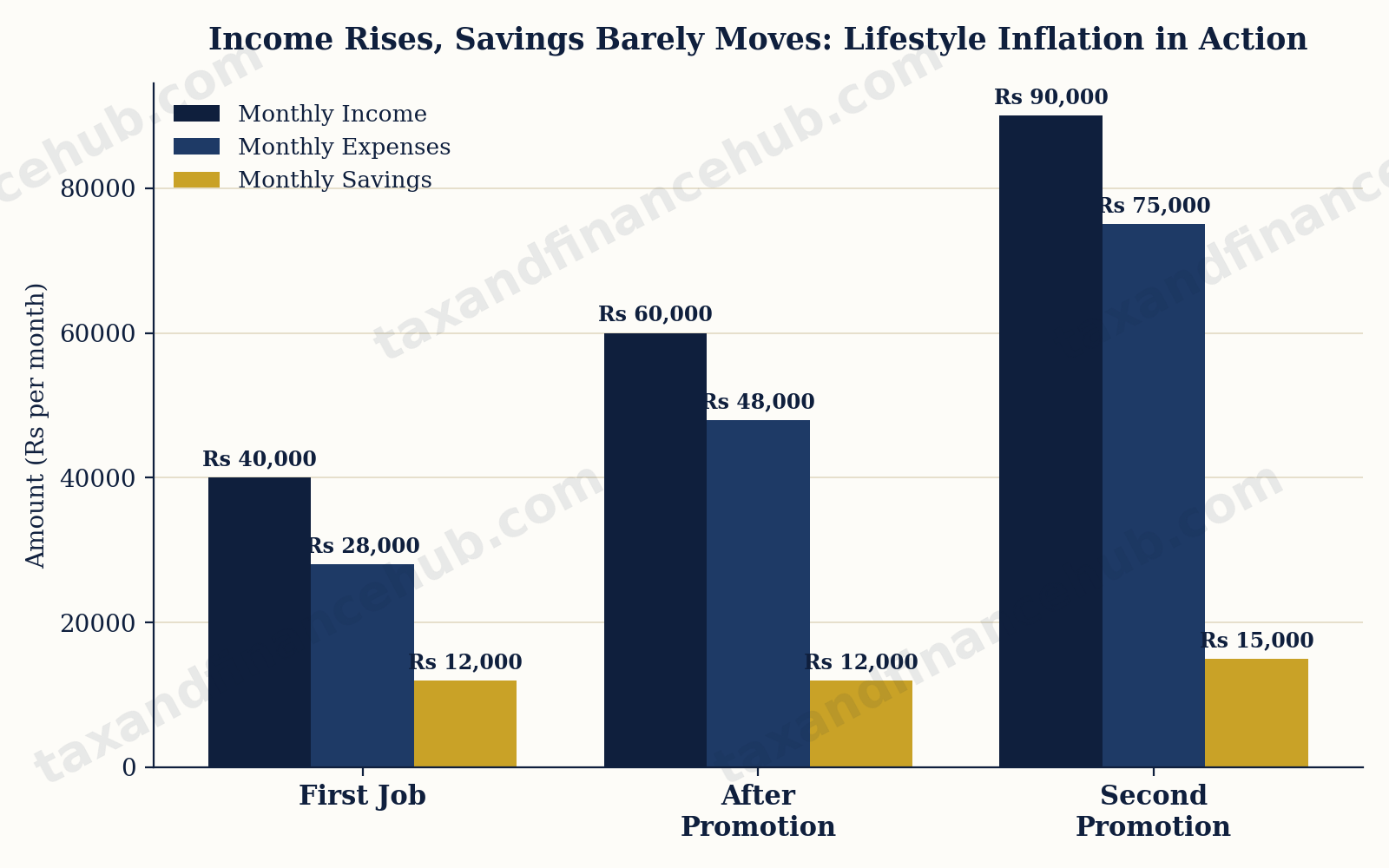
Income more than doubled—but savings barely moved.
|
Key Lesson A higher income does not automatically lead to greater wealth. Sustainable wealth grows when savings and investments increase faster than expenses. |
How Lifestyle Inflation Happens
Lifestyle inflation usually develops gradually rather than overnight. It often follows a predictable pattern:
| 1 |
Income Increases A salary hike, bonus, promotion, business profit, or new job provides additional disposable income. |
| ↓ | |
| 2 |
Spending Increases Instead of saving or investing, spending expands to match the higher income. |
| ↓ | |
| 3 |
New Lifestyle Becomes Normal What initially felt like a luxury soon becomes a necessity. |
| ↓ | |
| 4 |
Savings Stop Growing Despite earning more, financial progress slows because higher expenses consume the additional income. |
Why Does Lifestyle Inflation Happen?
Lifestyle inflation is driven by both psychological and social factors. Understanding these influences can help you make more intentional financial decisions.
1. Social Comparison
People often compare themselves with friends, relatives, colleagues, or influencers on social media. Seeing others enjoy luxury cars, expensive vacations, or premium gadgets can create pressure to spend more, even when it doesn’t align with personal financial goals.
2. Rewarding Yourself
After working hard for a promotion or salary increase, it’s natural to want to celebrate. While occasional rewards are healthy, turning every income increase into a permanent rise in spending can be financially damaging.
3. Easy Access to Credit
Credit cards, personal loans, and Buy Now, Pay Later (BNPL) services make it easier to afford expensive purchases without paying the full amount upfront. This convenience can encourage overspending.
4. Marketing and Consumer Culture
Businesses constantly promote newer and more premium products. Attractive advertisements, festive sales, and influencer endorsements can create a sense that upgrading is necessary, even when existing products still meet your needs.
5. Inflation and Rising Living Costs
Not every increase in spending is lifestyle inflation. Some expenses rise due to inflation or genuine changes in circumstances, such as marriage, children, or relocating to a more expensive city. The key is to distinguish between essential cost increases and discretionary lifestyle upgrades.
Signs You May Be Experiencing Lifestyle Inflation
Ask yourself the following questions:
- •Do you spend most of your salary before the next payday?
- •Have your savings remained the same despite salary hikes?
- •Do you frequently upgrade gadgets without a genuine need?
- •Have you increased spending on dining, shopping, or entertainment simply because you can afford it?
- •Do you rely on credit cards for lifestyle expenses?
- •Have your monthly subscriptions increased over time?
- •Do you feel pressured to maintain a certain lifestyle to match others?
|
Reality Check If your answer to several of these questions is “Yes,” you may be experiencing lifestyle inflation. |
Lifestyle Inflation vs. Healthy Lifestyle Improvement
It’s important to understand that not all increases in spending are harmful. Investing in your health, education, or safety can improve your quality of life and future earning potential.
| Healthy Lifestyle Improvement | Lifestyle Inflation |
|---|---|
| Purchasing quality health insurance | Buying luxury items mainly for status |
| Learning new skills or certifications | Frequent expensive gadget upgrades |
| Investing in ergonomic furniture for better health | Replacing perfectly functional furniture for trends |
| Spending on preventive healthcare | Impulse shopping without long-term value |
| Buying reliable household appliances | Purchasing premium brands solely for prestige |
The difference lies in intent and long-term value. Spending that supports your well-being or increases your future income is often worthwhile, while spending driven by social pressure or impulse may contribute to lifestyle inflation.
Real-Life Examples of Lifestyle Inflation
Example 1: The Salary Hike
Rahul receives a ₹20,000 monthly salary increase. Instead of investing the additional amount, he upgrades to a luxury apartment and finances a new car. Within months, his monthly expenses increase by nearly the same amount as his salary hike.
Example 2: The Business Owner
Priya’s business profits grow significantly. Rather than building an emergency fund or expanding her investments, she purchases luxury watches, travels more frequently, and hosts lavish parties. Although her income rises, her net worth grows slowly because of higher spending.
Example 3: The Young Professional
A software engineer begins earning ₹1.5 lakh per month. Premium subscriptions, weekend vacations, food delivery, branded clothing, and gadget upgrades gradually become routine. Despite a high salary, there is little money left for long-term investments.
Quick Self-Assessment Checklist
Rate yourself by answering Yes or No:
| Question | Yes / No |
|---|---|
| Have your monthly expenses increased significantly after your last salary hike? | |
| Do you save less than 20% of your monthly income? | |
| Do you often buy things to celebrate achievements? | |
| Have your EMIs increased because of lifestyle purchases? | |
| Do you frequently compare your lifestyle with others? | |
| Do you upgrade gadgets more for desire than necessity? |
Interpretation
- ✓0–1 Yes: You are managing your spending well.
- ✓2–4 Yes: Be mindful of lifestyle inflation.
- ✓5–6 Yes: Your financial goals may be at risk unless you reassess your spending habits.
Part 2 of 3
Causes, Financial Impact, Risks & Case Studies
|
“Wealth is not measured by how much you earn—it is measured by how long your money can support your lifestyle.” |
In Part 1, we understood what lifestyle inflation is, why it happens, and how to identify its warning signs.
In this part, we will examine the deeper financial consequences of lifestyle inflation. While it may appear harmless initially, lifestyle inflation can significantly delay wealth creation, reduce financial security, and increase dependence on debt if left unchecked.
What Causes Lifestyle Inflation?
Lifestyle inflation is rarely caused by a single event. It usually develops through a combination of financial, psychological, and social influences.
1. Salary Hikes and Promotions
One of the most common triggers is an increase in income. Many people assume that because they earn more, they should immediately spend more. Instead of increasing investments, they upgrade their home, vehicle, gadgets, or daily lifestyle.
| Where the ₹25,000 Hike Went | Amount |
|---|---|
| Car EMI increase | ₹12,000 |
| Dining expenses increase | ₹5,000 |
| Shopping increase | ₹4,000 |
| Premium subscriptions increase | ₹2,000 |
| Remaining for savings | ₹2,000 |
|
Financial Lesson Income growth should ideally increase your investments before increasing your lifestyle. |
2. Social Media Influence
Today’s social media platforms constantly showcase luxury vacations, expensive gadgets, premium restaurants, branded clothing, and luxury cars. People often compare their everyday life with someone else’s highlight reel. This creates unnecessary pressure to “keep up,” leading to spending that is driven more by appearances than by personal financial goals.
3. Peer Pressure
Lifestyle inflation is common among professionals. Examples include friends buying premium smartphones, colleagues upgrading cars, relatives purchasing luxury homes, and neighbours renovating frequently.
Instead of asking, “Can I afford this?” people often ask, “Will I look successful without it?”
4. Easy Availability of Credit
Modern banking has made borrowing easier than ever — credit cards, Buy Now Pay Later (BNPL), consumer loans, zero-cost EMI schemes, and instant personal loans. These facilities reduce the pain of spending because payment is delayed. As a result, people often purchase items that exceed their actual financial capacity.
5. Rising Income Without a Financial Plan
Many people focus on earning more but never develop a strategy for managing additional income. Without predefined rules such as saving first, investing before spending, or maintaining a budget, extra income usually disappears through increased lifestyle expenses.
6. Emotional Spending
Many purchases are driven by emotions rather than necessity. Common emotional triggers include stress, celebrations, loneliness, rewards after hard work, and fear of missing out (FOMO). These expenses provide temporary satisfaction but often become recurring habits.
Major Financial Risks of Lifestyle Inflation
Lifestyle inflation affects far more than monthly savings. Its long-term impact can be substantial.
1. Lower Savings Rate
Suppose two individuals each earn ₹1,20,000 per month:
| Particulars | Person A | Person B |
|---|---|---|
| Monthly Income | ₹1,20,000 | ₹1,20,000 |
| Monthly Expenses | ₹60,000 | ₹1,00,000 |
| Monthly Savings | ₹60,000 | ₹20,000 |
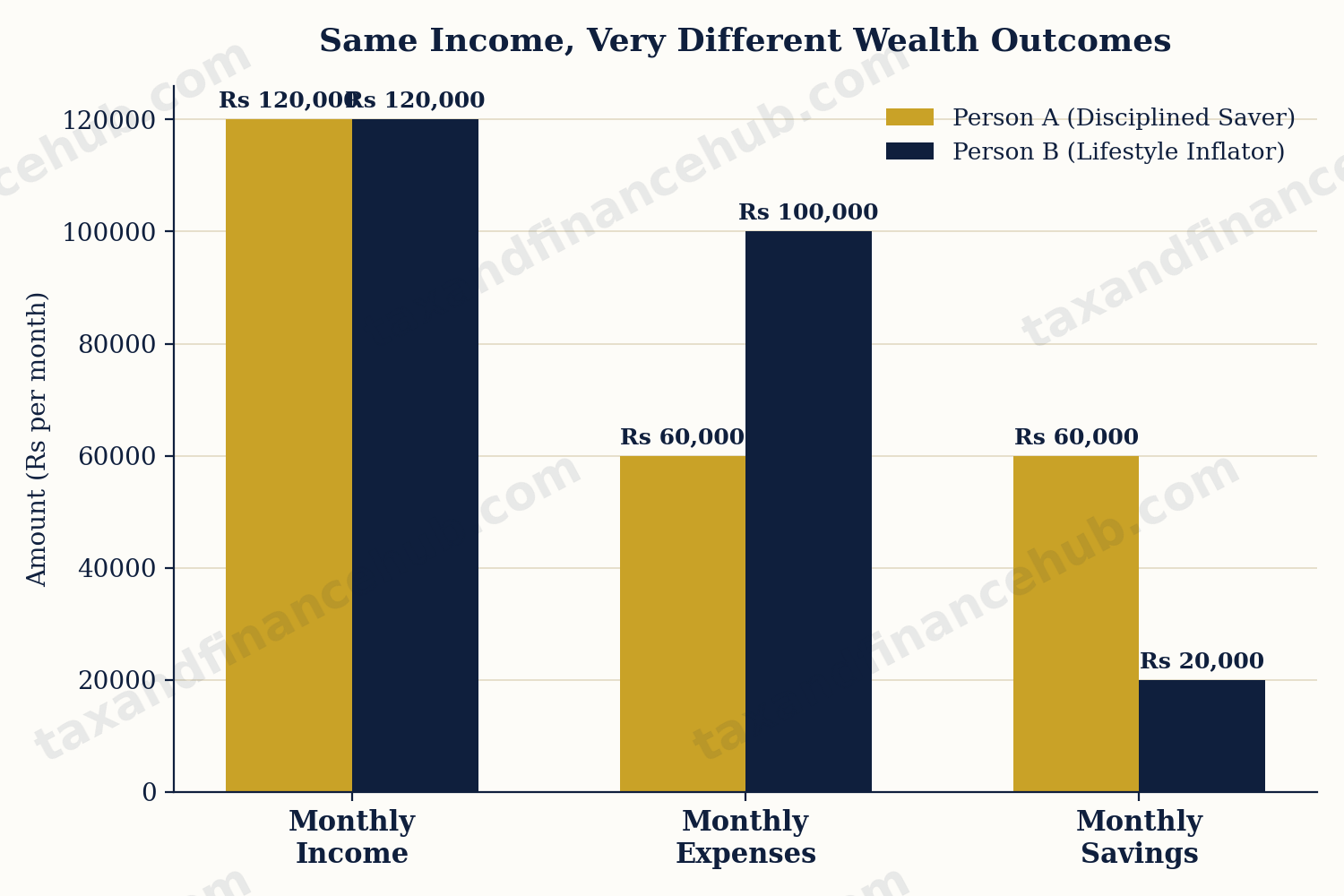
Over time, Person A accumulates significantly more wealth despite earning the same salary.
|
Takeaway Saving Rate matters more than Income. |
2. Reduced Investment Growth
Money spent today loses the opportunity to grow through compounding. Suppose you spend an additional ₹20,000 every month on lifestyle upgrades instead of investing it.
| Monthly Investment | Annual Return | Period | Estimated Value |
|---|---|---|---|
| ₹20,000 | 12% | 20 Years | ≈ ₹2 Crore |
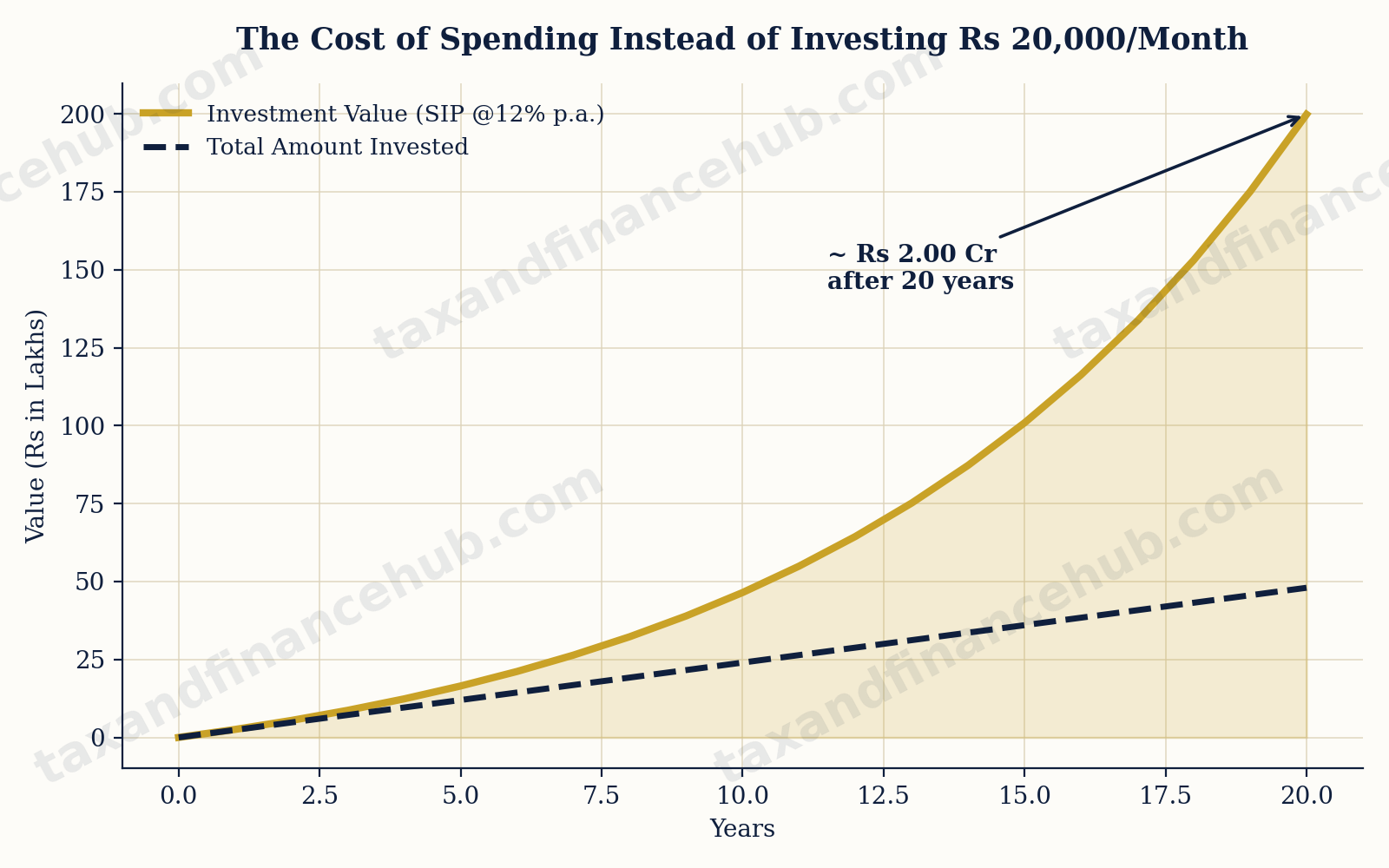
Illustrative calculation based on assumed annual returns; actual investment returns may vary.
This demonstrates the opportunity cost of lifestyle inflation.
3. Delayed Retirement
Higher expenses require a larger retirement corpus.
| Monthly Lifestyle Cost | Scenario |
|---|---|
| ₹50,000 | Today |
| ₹1,20,000 | After years of lifestyle inflation |
The second lifestyle requires substantially higher retirement savings, meaning more years of work, greater financial pressure, and increased dependence on active income.
4. Increased Financial Stress
Higher lifestyles often create larger EMIs, bigger home loans, higher insurance premiums, increased maintenance expenses, and greater monthly obligations. During economic uncertainty or job loss, these commitments become difficult to sustain.
5. Poor Emergency Preparedness
People affected by lifestyle inflation often have expensive cars, premium phones, and luxury vacations — but no emergency fund, low savings, and limited investments. An unexpected medical emergency or job loss can quickly create financial hardship.
Lifestyle Inflation and Debt
Lifestyle inflation frequently leads to unnecessary borrowing.
| Purchase | Usually Necessary? | Often Financed Through |
|---|---|---|
| Luxury Smartphone | No | Credit Card EMI |
| Premium Furniture | Sometimes | Consumer Loan |
| Luxury Car | Depends | Vehicle Loan |
| Foreign Vacation | No | Credit Card |
| Designer Goods | No | BNPL |
Although EMIs may appear affordable individually, multiple commitments can consume a large portion of monthly income.
Lifestyle Inflation Across Different Income Levels
Contrary to popular belief, lifestyle inflation affects everyone.
| Income Group | Common Lifestyle Inflation |
|---|---|
| Students | Expensive gadgets, dining, subscriptions |
| Young Professionals | Cars, vacations, premium phones |
| Mid-Career Employees | Bigger homes, international travel, branded shopping |
| High-Income Professionals | Luxury vehicles, premium clubs, multiple properties |
| Business Owners | Status-driven spending, luxury assets |
|
Bottom Line Lifestyle inflation is driven by behaviour — not income level. |
Case Study 1: The High Earner Who Never Built Wealth
Amit — Monthly Income: ₹2,50,000
Monthly expenses: luxury apartment, SUV EMI, premium memberships, frequent travel, and dining out.
Monthly Savings: ₹15,000
Despite earning ₹30 lakh annually, Amit struggled to build meaningful wealth because most of his income funded an expensive lifestyle.
Case Study 2: The Disciplined Professional
Sneha — Monthly Income: ₹90,000
Monthly Savings: ₹35,000
Investment strategy: Mutual Funds through SIP, Public Provident Fund (PPF), an Emergency Fund, and Equity Investments.
She avoided unnecessary upgrades after every salary hike and steadily increased her investments. Over time, disciplined investing and the power of compounding positioned her to build greater long-term wealth than many higher earners.
|
Lesson Financial discipline often has a greater impact on wealth creation than income alone. |
Opportunity Cost of Lifestyle Inflation
Every unnecessary expense represents money that could have been invested.
| Instead of Buying… | You Could Invest In… |
|---|---|
| Luxury Phone Upgrade | Equity Mutual Fund SIP |
| Luxury Vacation | Emergency Fund |
| Premium Car | Retirement Corpus |
| Designer Clothing | Index Funds |
| Frequent Dining Out | Children’s Education Fund |
Small financial decisions, repeated consistently, shape long-term wealth.
Warning Signs That Lifestyle Inflation Is Becoming Dangerous
Watch for these indicators:
- •Savings rate is declining despite salary increases
- •Credit card balances are growing every month
- •EMIs consume a significant share of your monthly income
- •You purchase items mainly to impress others
- •You feel financially stressed despite earning a good salary
- •Salary hikes disappear within a few months
- •Investments are postponed because “there isn’t enough money”
If several of these signs apply to you, it may be time to review your spending habits and realign them with your financial goals.
Key Takeaways
- ✓Lifestyle inflation often begins gradually and becomes a habit before you notice it.
- ✓Increasing income does not automatically improve financial health if expenses rise at the same pace.
- ✓The biggest hidden cost of lifestyle inflation is the loss of future wealth through missed investment opportunities.
- ✓A higher savings and investment rate generally contributes more to long-term financial security than a higher income alone.
Part 3 of 3
How to Avoid Lifestyle Inflation & Build Wealth
|
“Every salary hike gives you two choices: upgrade your lifestyle or upgrade your future.” |
In Part 1, we understood what lifestyle inflation is and how it develops. In Part 2, we explored its causes, financial risks, and long-term impact on wealth creation.
Now, let’s focus on the most important question: How Can You Prevent Lifestyle Inflation?
The goal isn’t to stop enjoying life. Instead, it’s to ensure that your income grows faster than your expenses so you can achieve financial freedom while still enjoying the present.
10-Step Action Plan to Avoid Lifestyle Inflation
1. Follow the “Pay Yourself First” Rule
Whenever you receive your salary: invest first, save next, and spend what remains. Avoid the common mistake of saving whatever is left at the end of the month — in many cases, nothing remains.
|
Pro Tip Set up automatic transfers to your investment and savings accounts immediately after your salary is credited. |
2. Save at Least 50% of Every Salary Increment
A practical approach is to split every salary hike.
| Allocation | Amount (on a ₹20,000 hike) |
|---|---|
| Increase SIPs / Investments | ₹10,000 |
| Lifestyle Upgrade | ₹10,000 |
This allows you to enjoy the rewards of your hard work while steadily building wealth.
3. Increase Investments Before Expenses
Whenever your income rises: increase your SIPs, add to your emergency fund, make additional retirement contributions, and prepay high-interest loans. Only then consider increasing discretionary spending.
4. Create a Budget That Works
One popular budgeting framework is the 50-30-20 Rule.
| Category | % | Examples |
|---|---|---|
| Needs | 50% | Rent, groceries, utilities, insurance |
| Wants | 30% | Dining out, entertainment, travel |
| Savings & Investments | 20% | SIPs, PPF, retirement, emergency fund |
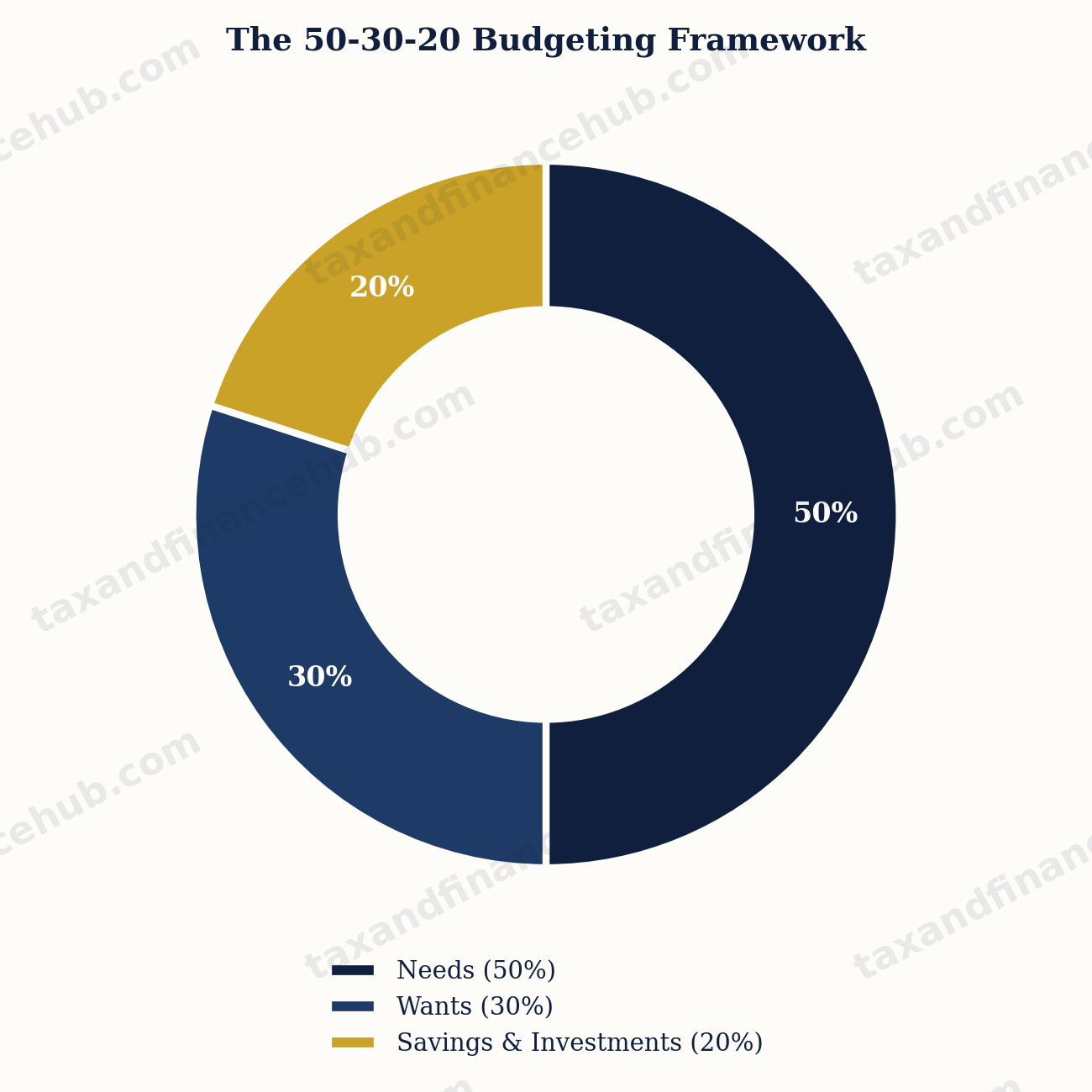
Tip: as your income grows, try increasing the savings percentage instead of the “wants” category.
5. Define Your Financial Goals
People without financial goals are more likely to spend impulsively. Write down your goals across different time horizons:
| Horizon | Example Goals |
|---|---|
| Short-Term (1–3 Years) | Emergency fund, family vacation, vehicle purchase, skill development |
| Medium-Term (3–7 Years) | Home down payment, children’s education fund, business expansion |
| Long-Term (10+ Years) | Retirement planning, financial independence, wealth creation, legacy planning |
Clear goals help you evaluate whether a purchase brings you closer to — or further from — your priorities.
6. Differentiate Between Wants and Needs
Before making a purchase, ask yourself:
- •Do I genuinely need this?
- •Will this improve my life in a meaningful way?
- •Can I comfortably afford it?
- •Will I still value it after six months?
If the answer is “No” to most questions, consider postponing the purchase.
7. Avoid Lifestyle Comparisons
Remember: every person’s financial journey is different, social media often highlights successes and not financial struggles, and someone driving a luxury car may also be carrying significant debt. Focus on your own financial goals rather than keeping up with others.
8. Review Your Spending Every Month
At the end of each month, review your expenses. Ask yourself where your money went, which expenses added real value, which can be reduced, and whether your savings increased. A simple monthly review can reveal spending patterns before they become long-term habits.
9. Maintain an Emergency Fund
A well-funded emergency reserve reduces the need to rely on loans or credit cards during unexpected situations. A common guideline is to maintain 3–6 months’ worth of essential living expenses, though the ideal amount depends on factors such as job stability, family responsibilities, and income sources.
10. Celebrate Wisely
It’s perfectly fine to reward yourself after achieving milestones — the key is moderation. Balanced celebrations include a memorable dinner with family, a short holiday within your budget, or buying a quality item you’ve genuinely planned for. Avoid making every salary increase a reason for large, recurring expenses.
30 Practical Tips to Control Lifestyle Inflation
Income & Savings
- •Increase your SIP after every salary hike.
- •Save first, spend later.
- •Avoid spending your annual bonus immediately.
- •Keep separate savings for financial goals.
- •Build multiple income streams.
Spending Habits
- •Wait 24–48 hours before making expensive purchases.
- •Compare prices before buying.
- •Avoid impulse shopping.
- •Prepare a shopping list.
- •Unsubscribe from promotional emails that trigger unnecessary purchases.
Debt Management
- •Pay credit card bills in full whenever possible.
- •Avoid financing luxury purchases through EMIs.
- •Borrow only for genuine needs.
- •Review loan obligations periodically.
- •Prioritize repayment of high-interest debt.
Investments
- •Increase investments annually.
- •Diversify appropriately based on your goals and risk tolerance.
- •Stay invested for the long term.
- •Review your portfolio regularly.
- •Avoid frequent buying and selling based on market emotions.
Lifestyle
- •Cook at home more often.
- •Limit unnecessary subscriptions.
- •Choose experiences over expensive possessions.
- •Buy quality products that last.
- •Appreciate what you already own.
Mindset
- •Define what “enough” means for you.
- •Practice gratitude.
- •Avoid comparing your finances with others.
- •Focus on net worth rather than outward appearances.
- •Remember that financial freedom often provides more lasting satisfaction than luxury consumption.
Lifestyle Inflation vs. Wealth Creation
| Lifestyle Inflation | Wealth Creation |
|---|---|
| Spend salary increase | Invest salary increase |
| Upgrade lifestyle immediately | Upgrade investments first |
| Higher EMIs | Higher investment portfolio |
| Growing monthly obligations | Growing passive income |
| Financial stress | Financial security |
| Dependence on active income | Progress toward financial independence |
Frequently Asked Questions (FAQs)
Q1. Is lifestyle inflation always bad?
No. Improving your quality of life is a natural and often positive outcome of higher income. Lifestyle inflation becomes a concern when spending grows so much that it limits your ability to save, invest, or achieve important financial goals.
Q2. What is the difference between inflation and lifestyle inflation?
Inflation refers to a general rise in the prices of goods and services across the economy. Lifestyle inflation occurs when your personal spending increases because your income has increased, often through discretionary lifestyle upgrades.
Q3. How much of a salary hike should I save?
There is no universal rule, but many financial planners recommend directing a significant portion — often at least 50% — of every salary increase toward savings, investments, or debt reduction.
Q4. Can high-income earners also suffer from lifestyle inflation?
Yes. Lifestyle inflation is based on spending behaviour, not income level. Even individuals with very high salaries can face financial stress if their expenses rise as quickly as their earnings.
Q5. Does lifestyle inflation affect retirement planning?
Yes. Higher recurring expenses mean you’ll typically need a larger retirement corpus to maintain the same standard of living after retirement.
Q6. Can lifestyle inflation lead to debt?
Yes. If lifestyle upgrades are financed through credit cards, personal loans, or EMIs without proper planning, they can increase debt and financial pressure.
Final Thoughts
Lifestyle inflation is subtle. It rarely feels like a problem in the beginning because rising income makes higher spending seem affordable.
However, the most financially successful people are often those who allow their income to grow faster than their lifestyle. They increase investments, strengthen their emergency funds, reduce unnecessary debt, and spend intentionally.
The objective isn’t to avoid enjoying life — it’s to ensure that today’s comforts do not come at the cost of tomorrow’s financial security.
|
Remember A balanced approach allows you to enjoy the present while steadily building wealth for the future. |
Key Takeaways
- ✓Lifestyle inflation is the gradual increase in spending as income rises.
- ✓Small recurring lifestyle upgrades can significantly reduce long-term wealth.
- ✓Saving and investing a portion of every salary increase can help accelerate financial growth.
- ✓Avoid comparing your financial journey with others.
- ✓Review your budget regularly and spend with intention.
- ✓Long-term financial success depends more on disciplined habits than on income alone.
Related Reading on Tax & Finance Hub
- •SIP Basics: A Beginner’s Guide to Systematic Investment Plans
- •How to Build an Emergency Fund
- •Budgeting for Beginners
- •Financial Planning Mistakes to Avoid
- •Power of Compounding Explained
- •Personal Finance Basics
- •Income Tax Saving Investments under the Income Tax Act (where applicable)
Disclaimer
This article is intended for educational and informational purposes only. It does not constitute financial, investment, tax, or legal advice. Financial decisions should be based on your individual goals, risk tolerance, and circumstances. Consider consulting a qualified financial professional before making significant investment or financial planning decisions.

With over a decade of hands-on experience in GST (Goods & Services Tax), Income Tax, and financial compliance, we founded Tax & Finance Hub with one mission: to make taxation simple, practical, and accessible for every Indian. His articles cut through legal jargon to deliver clear, real-world guidance — verified against the latest laws, circulars, and notifications.