SPECIAL FEATURE • TAX & FINANCE HUB
From Pharaohs to Form 16
The Extraordinary Evolution of Taxation
From ancient grain levies to GST — a 5,000-year journey through the bizarre, brilliant, and occasionally hilarious history of tax.
Tax & Finance Hub • Comprehensive Analysis • Updated 2026
CHAPTER ONE
The World’s Oldest Profession
(No, Not That One)
Long before spreadsheets and Section 80C, humans were already taxing each other.
If you’ve ever grumbled about paying taxes, know this: you are part of a tradition stretching back at least 5,000 years. Taxation predates the wheel, the alphabet, and quite possibly the concept of a sensible government. It is one of humanity’s oldest — and most reliably annoying — institutions. The word “tax” itself comes from the Latin taxare, meaning “to appraise or estimate.” But long before the Romans coined the term, civilisations across the globe had developed surprisingly sophisticated ways of relieving citizens of their wealth — all in the name of the greater good, of course.
“In this world, nothing is certain except death and taxes.”
—
Benjamin Franklin, 1789. Clearly a man who had filed a return or two.
|
🎉 FUN FACT: The First Tax Collectors Were Feared Ancient Egyptian tax scribes were called ‘scribes of the double house of life’. They travelled the Nile delta on official papyrus-stamped authority. Defy them and you risked forced labour on the nearest pyramid. Even by ancient standards, nobody ghosted the taxman. |
🌍 World Tax Timeline
|
3000 |
Ancient Egypt — The OG Tax Collector The Pharaohs ran the world’s first organised tax system. Every two years, the Pharaoh conducted a ‘census of all wealth’ — livestock, grain, gold. Failure to pay meant labour on royal projects. Tax officers, called ‘scribes,’ were the most feared people in the Nile delta — a tradition that lives on in many finance ministries today. |
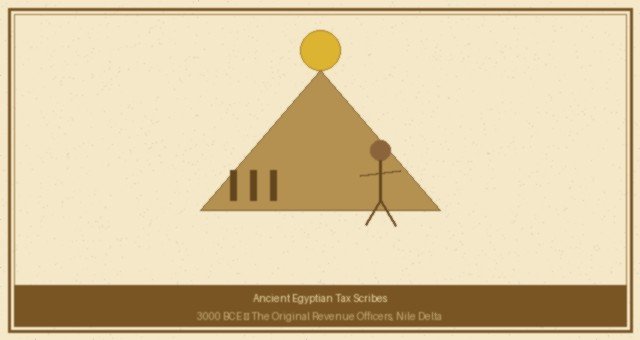
▲ Ancient Egyptian Tax Scribes — The original revenue officers of the Nile
(3000 BCE)
|
600 |
Ancient Greece — Tax as a Mark of Shame In Athens, wealthy citizens funded public services through a system called liturgy. Refusing was deeply shameful. Citizens could even challenge each other: if you claimed someone else was richer than you, that person either paid the liturgy or swapped all their property with you. Nothing like competitive philanthropy to keep the economy moving. |
|
200 |
The Roman Empire — Tax Goes Industrial Rome perfected the art of extracting money from conquered territories. They introduced a general income tax (tributum), a poll tax, a sales tax on slaves, and an inheritance tax. Rome also pioneered ‘tax farming’ — selling the right to collect taxes to private contractors who kept a profit margin. This was absolutely not corrupt at all. Definitely not. |
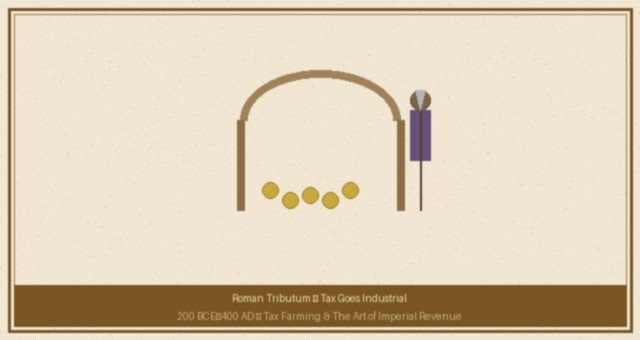
▲ Roman Tributum — When the Empire said ‘pay up’, conquered territories listened
(200 BCE–400 AD)
|
500–1400 |
Medieval Europe — Pay Everyone, Always The medieval citizen paid crops to the local lord (tallage), 10% to the Church (tithe), and various levies to the Crown for wars, coronations, and royal weddings — yes, subjects were taxed when the king got married. The concept of ‘no taxation without representation’ was centuries away. ‘Taxation despite absolutely no representation whatsoever’ was very much alive. |

▲ Medieval Tithe — Crops for the lord, grain for the Church, hope for no surprise royal wedding
(500–1400 AD)
|
1799 |
Britain Invents Income Tax — To Fight Napoleon PM William Pitt the Younger introduced the world’s first modern income tax in 1799 — a ‘temporary’ measure to fund the Napoleonic wars. It was meant to last only as long as the war. Spoiler: income tax still exists in Britain. Starting at 2 pence per pound, rising to a 10% maximum — roughly what a single Indian surcharge adds today. |
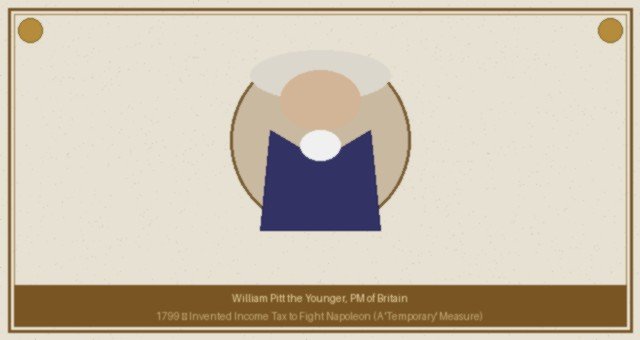
▲ William Pitt the Younger — “This income tax is temporary.” (It wasn’t.) Britain, 1799.
|
1913 |
The United States — Making It Constitutional After a brief Civil War-era income tax, the US permanently instituted federal income tax with the 16th Amendment. The top rate started at 7% on incomes above $500,000, later peaking at 94% during World War II. The IRS was born, and with it, an entire genre of American comedy writing. |
|
1954–Present |
The Age of Value Added Tax The modern era brought VAT, first introduced in France in 1954. The idea: tax the ‘value added’ at each stage of production. This spread to 160+ countries. India’s version — the Goods and Services Tax — arrived in 2017. The rest of the world needed 63 years to adopt the idea. India spent those 63 years debating it in Parliament. |
CHAPTER TWO
Laws That Made the Accountants Laugh
(And Then Cry)
History’s most magnificently misjudged tax laws — presented without further apology.
|
🪟 England The Window Tax King William III taxed windows. The more windows a house had, the more you paid. Citizens responded by bricking them up. The country plunged into literal darkness to avoid taxes. Doctors warned of epidemic disease. The tax persisted for 156 years. The original ‘lights out’ austerity measure. |
🧔 Russia Peter the Great’s Beard Tax Peter the Great taxed beards. If you wanted to keep your facial hair, you paid an annual fee and received a brass token as proof. The amount varied by social class — nobles paid more than peasants. The original facial-hair surcharge. |
|
|
🎩 England The Hat Tax Britain taxed hats. Hat sellers needed licences. Every hat required an Fashion crime, quite literally. |
💊 USA, The Illegal Drug Tax Tennessee required dealers of illegal drugs to anonymously purchase tax stamps for their controlled substances. Dealers who paid received the stamps but received no immunity from prosecution. It was a tax on lawbreaking. Compliance was, understandably, low. |
|
|
☂️ Italy The In Conegliano, businesses were charged a ‘shadow tax’ if their awnings cast a shadow on public pavement. The logic: you are occupying public space with darkness, and darkness has a value. Umbra ergo taxo. |
⚰️ Austria The Austria once taxed coffins. To avoid paying repeatedly, some parishes created reusable coffins with a trapdoor at the bottom — the Truly a circular economy. |
|
|
🫐 USA, The Blueberry Tax Maine levies 1.5 cents per pound specifically on wild blueberries. Not farmed blueberries. Wild ones. The revenue funds blueberry research. The blueberries have not filed an appeal. Foraged. And taxed. |
🐕 Switzerland The Dog Tax Switzerland taxes dogs annually, with amounts calculated based on weight. A Great Dane costs more to own than a Chihuahua. Switzerland is meticulous about everything, including canine fiscal obligations. Bark if you want a rebate. |

▲ Peter the Great of Russia — He modernised the nation. He also taxed your
beard. Both were non-negotiable.
CHAPTER THREE
Taxation in India
An Epic Spanning 2,300 Years
From Kautilya’s Arthashastra to the GST Council — the full story.
If you believe the Indian government’s appetite for taxation is a modern phenomenon, the Arthashastra would like a word. Written around 300 BCE by Kautilya (Chanakya) — the original finance minister who could give most modern economists a run for their money — this treatise laid down a comprehensive taxation system covering land, trade, customs, licences, tolls, and professional income. In short: Kautilya taxed everything that moved, and put a toll booth on everything that stood still.
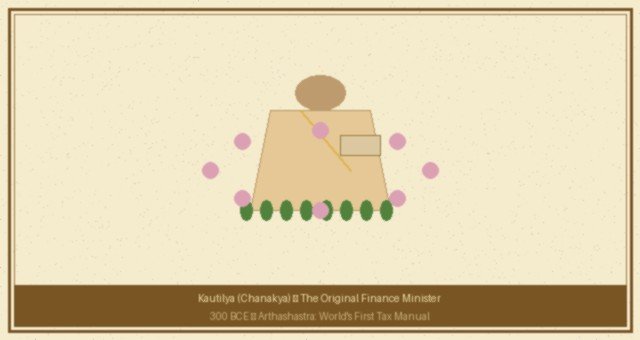
▲ Kautilya (Chanakya), 300 BCE — “Tax like a bee extracting honey: take without causing harm.” The Arthashastra on taxpayer relations.
Indian Tax Timeline
|
300 |
Kautilya’s Arthashastra — The World’s First Tax Manual The Arthashastra prescribed taxes on land (one-sixth of produce), customs duties (5–20%), taxes on manufactured goods, tolls on trade routes, and professional levies on artisans and merchants. |
|
320–185 |
The Maurya Empire — Taxation at Scale The Maurya state maintained a sophisticated revenue department taxing land, forests, mines, salt, fermented liquor, gambling establishments, and a 10% income tax on merchants. Ashoka later reduced many levies, making him arguably India’s first tax reformer and the first ruler to introduce something resembling a taxpayer’s charter. |
|
1000–1500 |
The Sultanate Period — A Multiplicity of Levies The Delhi Sultanate introduced kharaj (land tax — one-third to half of produce), jizya (poll tax on non-Muslims), and various transit duties. Alauddin Khalji fixed market prices and penalised merchants who overcharged with admirable, if alarming, efficiency. |
|
1556–1707 |
The Mughal Empire — Todar Mal’s Great Reform Akbar’s finance minister Raja Todar Mal revolutionised land taxation around 1580 with the Zabt system — surveying and classifying land into four productivity categories, standardising weights and measures, and calculating revenue based on the previous ten years’ average prices. India’s first attempt at scientific tax assessment — a precursor to ‘arm’s length pricing.’ |
▲ Raja Todar Mal, c. 1580 — Akbar’s tax reformer who surveyed every acre of the Empire. The original data-driven finance minister.
|
1760–1857 |
The East India Company — Extraction as a Business Model The Company’s Permanent Settlement of 1793 fixed land revenue in perpetuity with zamindars, shifting all agricultural risk onto the peasantry. It also maintained internal customs barriers between provinces — essentially taxing internal trade in a way that would today violate GST principles entirely. |
|
1860 |
The Birth of Income Tax in India James Wilson — founder of The Economist and Finance Member of the British Viceroy’s Council — introduced the first Income Tax Act in India in 1860. The tax was 2% on incomes above Rs 200 and was meant to be temporary. As with all temporary taxes in history, it became permanent. Indians were paying income tax while simultaneously agitating for freedom — a particularly exhausting combination. |
|
1947–1961 |
Independent India — Building a New Tax Architecture Post-Independence, India inherited a patchwork of colonial tax laws. After comprehensive review, the landmark Income Tax Act, 1961 was enacted — which continues to govern Indian income taxation today, though with so many amendments that the original Act resembles a palimpsest more than a statute. |
|
1961–2016 |
The Era of Reform — TDS, PAN, and Digital This era brought TDS as a withholding mechanism, the PAN system (made universal in 1995), computerisation of the Income Tax Department, and e-filing of returns from 2006. India’s direct tax-to-GDP ratio remained stubbornly low — reflecting both the difficulty of taxing an informal economy and the extraordinary creativity of the Indian taxpayer in locating deductions. |
|
2017 |
GST On the midnight of 30th June–1st July 2017, in a special joint session of Parliament modelled on India’s original independence ceremony, the Goods and Services Tax came into force. After 17 years of deliberation, India replaced a maze of 17 major indirect taxes and 23 cesses with a unified structure. PM Modi called it a ‘good and simple tax.’ The first GSTR filing season gently disagreed. |
CHAPTER FOUR
India’s Own Hall of Tax Legends
Contradictions & Classifications
That have kept tax professionals entertained and reaching for antacids.
|
🫓 GST Council — Present Paratha vs. Roti — The Great Flatbread Schism The AAR ruled that plain rotis attract 5% GST while parathas attract 18% — because parathas require more preparation. India’s legal system adjudicated the philosophical difference between a roti and a paratha. Legal philosophers are divided. Grandmothers are not. Your tawa, now a fiscal device. |
🥒 GST Classification — Present Pickle: The 12% Condiment Controversy Pickle (achar) attracts 12% GST. Tax practitioners have filed advance rulings on whether a chutney is a sauce, a sauce is a pickle, and where precisely the pickle ends and the relish begins. The GST HSN code for ‘preparations of vegetables’ spans 40+ sub-headings. Every jar now requires a tax opinion. |
|
|
🃏 Pre-GST History — Historical The Playing Card Tax India levied a specific excise duty on playing cards under the Central Excise Act — distinct from the tax on casino games, gambling, or the emotional toll of losing at rummy. The duty was calculated per pack. Dealt a tax hand. |
💎 Income Tax — 1957–2015 Wealth Tax — The Tax That Taxed Itself India’s Wealth Tax Act taxed ‘non-productive’ assets — jewellery, urban land, cars, yachts. It raised a modest Rs 1,000 crore per year while costing the government Rs 600 crore to administer. It was abolished in 2015 by Finance Minister Arun Jaitley, who perhaps ran the cost-benefit numbers. A tax worth less than itself. |
|
|
🎡 Amusement Tax — Pre-GST Tax on Entertainment Before It Was Cool Many Indian states levied an ‘amusement tax’ on cinema tickets, amusement parks, cable TV, and live performances. One state legislature spent significant floor time debating whether a theme park ride counted as ‘amusement’ or ‘sport’ — with different rates applicable. Joy: now attracting a cess. |
🍿 GST Curiosities — 2023 Popcorn’s Three-Tier Existence The GST Council clarified: salted/plain popcorn = 5%; caramelised popcorn = 18% (as a sugar confectionery); popcorn sold inside a cinema = 12% (as restaurant service). The same food item has three tax identities depending on preparation and location. Popcorn: most complicated snack in fiscal history. |
|
|
🎉 FUN FACT: The Popcorn Paradox In 2023, the GST Council spent time that could have been allocated to infrastructure and health policy deliberating the precise tax rate on caramelised popcorn. The conclusion: add sugar = 18%. Don’t add sugar = 5%. The cinema throws in the complication of a third rate entirely. This is the kind of nuance Kautilya’s Arthashastra did not anticipate. |
||
CHAPTER FIVE
Income Tax in India
The Full Journey
From James Wilson’s 2% experiment to faceless assessments and the New Tax Regime.
The Income Tax Act of 1961 has been amended by nearly every Finance Act since its enactment. It currently runs to over 700 sections, 23 chapters, and several thousand sub-clauses — a body of law so vast it has spawned an entire ecosystem of commentaries, circulars, notifications, advance rulings, tribunal orders, and high court judgments, each of which may be cited against you at any time.
The most significant structural change in recent decades was the introduction of the New Tax Regime in Budget 2020 (Section 115BAC), offering lower tax rates in exchange for foregoing most deductions. Initially optional, the new regime became the default regime from FY 2023-24. The 2025 Union Budget further liberalised it substantially.
📅 Key Milestones in Income Tax History
|
1860 |
First Income Tax Act Post-1857 revenue need — 2% on incomes above Rs 200. A ‘temporary’ measure. |
|
1886 |
First Comprehensive Act Full schedules introduced. The law began growing its legendary complexity. |
|
1922 |
Consolidated Act TDS introduced. The concept of deducting tax before you even see your money was born. |
|
1961 |
The Modern Income Tax Act Still in force. With more amendments than the original has clauses. |
|
1997 |
VDIS— Voluntary Disclosure Come clean, pay something, sleep better. A one-time amnesty that worked surprisingly well. |
|
2006 |
E-filing Launched India goes digital. No more posting returns and praying they arrived. |
|
2020 |
New Tax Regime (Optional) Lower rates, fewer deductions. Tax professionals began re-learning everything. |
|
2021 |
Faceless Assessments No more meeting your Assessing Officer. The algorithm is your new tax officer. |
|
2023 |
New Regime Default Unless you opted out, you were in. The old regime became the exception. |
|
2025 |
Major Liberalisation Rs 12 lakh rebate. Rs 75,000 standard deduction. New IT Bill passed. |
New Tax Regime Slabs — FY 2025-26 (AY 2026-27)
|
Income |
Tax |
Note |
|
Up to Rs 4,00,000 |
NIL |
Zero tax — no liability at all |
|
Rs 4,00,001 – Rs 8,00,000 |
5% |
Rs 20,000 on this slab |
|
Rs 8,00,001 – Rs 12,00,000 |
10% |
Rs 40,000 on this slab |
|
Rs 12,00,001 – Rs 16,00,000 |
15% |
Rs 60,000 on this slab |
|
Rs 16,00,001 – Rs 20,00,000 |
20% |
Rs 80,000 on this slab |
|
Rs 20,00,001 – Rs 24,00,000 |
25% |
Rs 1,00,000 on this slab |
|
Above Rs 24,00,000 |
30% |
On balance income |
★ Rebate u/s 87A: Total income up to Rs 12,00,000 = zero net tax under new regime. For salaried individuals (standard deduction Rs 75,000), effective zero-tax limit is Rs 12,75,000.
Old Tax Regime Slabs — FY 2025-26
|
Income Slab (Annual) |
Tax Rate |
Key Deductions Available |
|
Upto Rs 2,50,000 |
NIL |
— |
|
Rs 2,50,001 – Rs 5,00,000 |
5% |
Rebate u/s 87A makes this NIL |
|
Rs 5,00,001 – Rs 10,00,000 |
20% |
80C (Rs 1.5L), 80D, HRA, LTA etc. |
|
Above Rs 10,00,000 |
30% |
All deductions as applicable |
★ Surcharge applies on income above Rs 50 lakh. Health & Education Cess @ 4% applies on all tax amounts.
CHAPTER SIX
GST
— One Nation, One Tax, Many Forms
India’s Most Ambitious Tax Reform
Prior to July 1, 2017, a manufacturer in India dealt with: Central Excise Duty, Additional Excise Duty, Service Tax, Countervailing Duty, Special Additional Duty, VAT, Central Sales Tax, Octroi, Entry Tax, Purchase Tax, Luxury Tax, Entertainment Tax, and several more — all with different rates, forms, deadlines, and officers. GST replaced all of this with a dual-structure system: CGST for the Centre’s share, SGST/UTGST for the state’s share, and IGST for inter-state transactions. The four-tier rate structure accommodates the economic range from essential goods to luxury items.
📊 GST Rate Structure
|
0% Exempt Fresh |
5% Essential Packaged |
12% Standard Processed |
18% Standard Most |
28% Luxury Luxury |
|
🎉 FUN FACT: GST by the Numbers (2026) Rs 2.37 lakh crore — single-month GST collection record (April 2024). Over 1.5 crore registered taxpayers across India. 55+ GST Council meetings held to date. 13+ different GST return forms. The blueberry tax of Maine looks simple by comparison. |
CHAPTER SEVEN
Taxation in India — 2026
The Current Landscape
The year 2026 finds Indian tax administration at a fascinating inflection point. The government has consistently moved toward a philosophy of ‘trust first, verify digitally’ — replacing adversarial in-person assessments with algorithm-driven risk profiling, AI-assisted scrutiny selection, and faceless proceedings. For the compliant taxpayer, the experience has genuinely improved. For the non-compliant one, the net has become far harder to escape.
“We want to make the tax system simpler — not simple, but simpler. One is aspirational, the other is possible.”
—
The view of most Indian tax policymakers, paraphrased accurately but not quoted.
📋 Key 2026 Provisions
|
DIRECT TAX — KEY 2026 PROVISIONS
✓ New regime default — Rs 12L income tax-free ✓ Standard deduction Rs 75,000 for salaried/pensioners ✓ Updated Return (ITR-U): 24 months from AY end ✓ Pre-filled ITR with AIS/TIS — largely auto-filled ✓ TDS on virtual digital assets: 1% u/s 194S ✓ Section 43B(h): MSME payment deduction on actual basis ✓ New Income Tax Bill 2025 — passed by Parliament |
INDIRECT TAX / GST — KEY 2026 PROVISIONS ✓ GST rate rationalisation — 3-rate structure under discussion ✓ E-invoicing threshold lowered; near-universal adoption ✓ GSTR-1A: ✓ Online gaming: 28% GST on full face value ✓ GST ITC matching: System-driven restriction if supplier defaults ✓ GST on insurance: rationalisation discussion ongoing ✓ Mandatory Aadhaar authentication for GST registration |
The most significant development of 2025 was the introduction of the New Income Tax Bill, 2025 — passed after joint committee review to replace the Income Tax Act, 1961. The new Bill simplifies language,
removes redundant provisions, restructures the Act into clearer chapters, and introduces several taxpayer-friendly procedural changes. Tax professionals are cautiously optimistic. The commentary industry is less so — an entirely new corpus awaits authorship.
✅ The 2026 Taxpayer Checklist — What Changed for You
|
🎉 FUN FACT: Salaried Individual Upto Rs 12.75L = zero tax under new regime (with Rs 75,000 standard deduction). New regime is default — opt out actively if you want old regime. If you don’t opt out, the system decides for you. Benjamin Franklin would be impressed. Or terrified. |
|
🎉 FUN FACT: Business Owner Presumptive taxation limits revised upward. MSME payment clause u/s 43B(h) is live — deduction only on actual payment within due dates. E-invoicing may be mandatory for your turnover. Your accountant is having a complicated year. |
|
🎉 FUN FACT: Crypto / VDA Investor 30% flat tax. No loss set-off. 1% TDS on every transaction. No deductions except cost of acquisition. Losses cannot be offset across currencies. This is the most taxed asset class in India. The blockchain cannot hide you from the CBDT. |
|
🎉 FUN FACT: GST Registrant GSTR-1 must be filed before GSTR-3B. ITC auto-reversed if supplier hasn’t paid tax. E-invoicing compliance is crucial. Annual return filing threshold applies. The compliance calendar now runs year-round. |
FINAL WORD
From Kautilya’s Grain Levy to GSTR-3B
Across 5,000 years, one truth remains: the forms change. The principle does not.
Across 5,000 years and six continents, one truth has remained constant: governments will always find new things to tax, citizens will always find creative ways to minimise it, and somewhere in the middle, a tax professional will earn a perfectly honest living helping both sides understand the rules.
“The art of taxation consists in so plucking the goose as to obtain the largest amount of feathers with the least possible amount of hissing.”
—
Jean-Baptiste Colbert, Finance Minister of France, 1665. Some things don’t change.
Disclaimer: This article is intended for educational and informational purposes only and does not constitute legal, tax, or financial advice. Tax laws change frequently; please consult a qualified tax professional for advice specific to your situation. All figures and law references are based on information available as of mid-2026.
Tax & Finance Hub • Evolution of Taxation • 2026

A Tax professional with over a decade of hands-on experience in Tax and Finance. I love taxation and at Tax & Finance Hub, we are trying to make you fall in love with the same as well by simplifying complex GST, income tax, and finance topics for businesses and individuals across India.
© Tax & Finance Hub | All Rights Reserved | Reproduction without permission is prohibited